|
Welcome to issue twenty-two of The Attention Span Newsletter by me, Canan “Ja’anan” Marasligil.͏ ͏ ͏ ͏ ͏ ͏ ͏ ͏ ͏ ͏ ͏ ͏ ͏ ͏ ͏ ͏ ͏ ͏ ͏ ͏ ͏ ͏ ͏ ͏ ͏ ͏ ͏ ͏ ͏ ͏ ͏ ͏ ͏ ͏ ͏ ͏ ͏ ͏ ͏ ͏ ͏ ͏ ͏ ͏ ͏ ͏ ͏ ͏ ͏ ͏ ͏ ͏ ͏ ͏ ͏ ͏ ͏ ͏ ͏ ͏ ͏ ͏ ͏ ͏ ͏ ͏ ͏ ͏ ͏ ͏ ͏ ͏ ͏ ͏ ͏ ͏ ͏ ͏ ͏ ͏ ͏ ͏ ͏ ͏ ͏ ͏ ͏ ͏ ͏ ͏ ͏ ͏ ͏ ͏ ͏ ͏ ͏ ͏ ͏ ͏ ͏ ͏ ͏ ͏ ͏ ͏ ͏ ͏ ͏ ͏ ͏ ͏ ͏ ͏ ͏ ͏ ͏ ͏ ͏ ͏ ͏ ͏ ͏ ͏ ͏ ͏ ͏ ͏ ͏ ͏ ͏ ͏ ͏ ͏ ͏ ͏ ͏ ͏ ͏ ͏ ͏ ͏ ͏ ͏ ͏ ͏ ͏ ͏ ͏ ͏ ͏ ͏ ͏ ͏ ͏ ͏ ͏ ͏ ͏ ͏ ͏ ͏ ͏ ͏ ͏ ͏ ͏ ͏ ͏ ͏ ͏ ͏ ͏ ͏ ͏ ͏ ͏ ͏ ͏ ͏ ͏ ͏ ͏ ͏ ͏ ͏ ͏ ͏ ͏ ͏ ͏ ͏ ͏ ͏ ͏ ͏ ͏ ͏ ͏ ͏ ͏ ͏ ͏ ͏ ͏ ͏ ͏ ͏ ͏ ͏ ͏ ͏ ͏ ͏ ͏ ͏ ͏ ͏ ͏ ͏ ͏ ͏ ͏ ͏ ͏ ͏ ͏ ͏ ͏ ͏ ͏ ͏ ͏ ͏ ͏ ͏ ͏ ͏ ͏ ͏ ͏ ͏ ͏ ͏ ͏ ͏ ͏ ͏ ͏ ͏ ͏ ͏ ͏ ͏ ͏
|
#22/ THE MIRROR OF OUR LIVES
|
|
Welcome to issue twenty-two of The Attention Span Newsletter by me, Canan “Ja’anan” Marasligil. I’m a writer, a literary translator and an artist based in Amsterdam. Every other week, I take the time to reflect and offer a glimpse of how I see and feel the world through the lens of culture, art, translation, poetry and literature. 🎙️ an audio version of the attention span newsletter is available on your favourite podcast app: Spotify, Apple Podcasts, Overcast…or to listen on the attention span website.
|
|
|
reflections, Amsterdam (May 2023) |
|
|
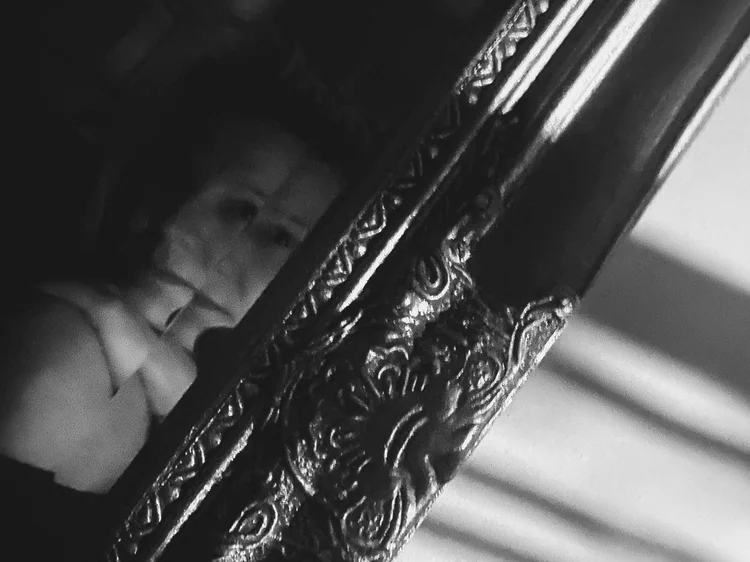
“and they recognized each other like italics.” —Anne Carson, Autobiography of Red: a Novel in Verse. Two languages, two cities, two seasons, two little girls looking exactly the same, both welcoming the story they are told by the adult voice with the same curiosity and passion. They may not be able to define the word passion, yet they’re inhabited by it. This is how we are introduced to La double vie de Véronique (The Double Life of Véronique), Krzysztof Kieślowski 1991 film in which a mysterious and mesmerising Irène Jacob plays both of the little girls in their adult years: Weronika, a Polish choir soprano, and Véronique, a French music teacher. Unaware of each other’s existence, the two women share an emotional bond, portrayed in the film through gorgeous reflections, enigmatic and shimmering colours, light and movements. A haunting musical score accompanies this beautiful visual treat (if you are unfamiliar with Kieślowski’s cinema, I invite you to dive into his world, you may like to start with his Three Colours Trilogy: Bleu, Blanc, Rouge, starring respectively Juliette Binoche, Julie Delpy and Irène Jacob.). The story of La double vie de Véronique carries a kind of mystery and magic which has become far too rare in today’s cinema. Beyond its cinematic beauty (or precisely because of it), the story of the two Véronique welcomes a deep reflection on how we connect to other lives. I remember vividly a dear friend of mine telling me how much she has loved this film, watching it when she was younger with her best friend in the small town where they were based, dreaming of other worlds, another life, “Véronique, c’est moi !” she said to me. She is me, she is you. We all have a Véronique somewhere in the world.
|
|
|
reflections, Amsterdam (May 2022) |
|
|
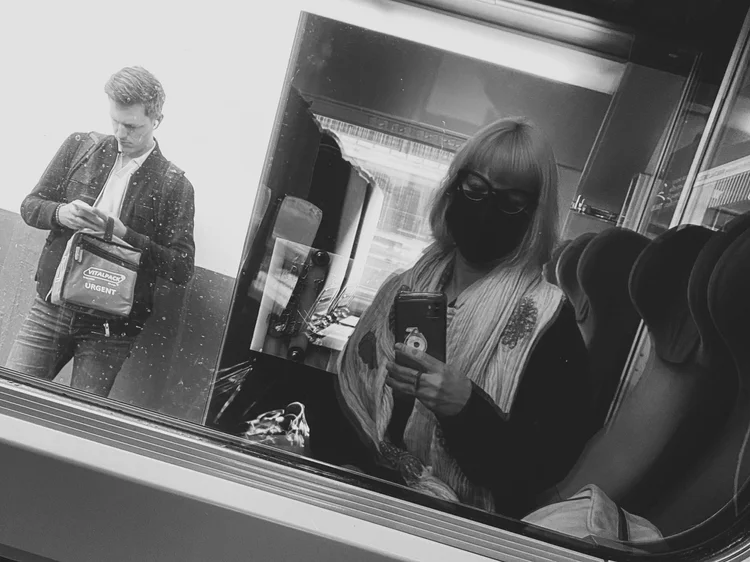
I’ve been haunted by this reflection of another self forever. Since my earliest childhood, I have never stopped searching for complexity through recognising myself in others. I used to have an imaginary friend who has accompanied me for a long time. I believe that when I let go of this figment of my imagination - who felt very real to me, I turned first to theatre, then to literary translation. While enacting characters in a play I could recreate myself. Digging into emotions and finding ways to understand other people’s lives. I have always tried to find myself in strangers. That is also how I find many parallels between acting and translating. My translator self constantly makes me curious about others, their lives, their contexts, their languages, and this process pushes me to find or create another version of me. Capturing myself in mirror reflections, in encounters I make traveling from home to home on a fast train, photographing in a split second someone I will never see again, but who will be forever archived in my hard drive to become part of my imagined memory. A new imaginary friend. One, two, three, more and many. The more I reflect on the world we live in, the less I understand how we have become so incapable of looking for ourselves in other living souls. This reality is painful for someone who feels other people’s existence close to our own this deeply.
|
|
|
reflections, Brussels-Amsterdam (June 2022) |
|
|
Cinema can be a powerful mirror of our lives, a confronting one too. Earlier today, I have watched The Zone of Interest, Jonathan Glazer’s Oscar winning film, at my local cinema. Loosely adapted from a novel by Martin Amis, it is the story of a Nazi commandant and his wife and family, living right next to a death camp in Auschwitz. A chilling account of what Hannah Arendt had coined the banality of evil. The film’s title refers to the term used by the Nazis to describe the immediate area around the concentration camp. As described in this Guardian interview with the director, “Played by German actors Christian Friedel and Sandra Hüller, the couple are the embodiment of the Jewish writer Primo Levi’s insistence that it is ordinary people, rather than monsters, who are capable of committing atrocity.” Next to the importance of what this particular story tells us about the responsibility of regular people in the Holocaust, it also scares me deeply to read it as a metaphor of what we are experiencing today with the genocide in Gaza. I see this film also as a reflection of our having created a wall between the reality of that violence, and our daily lives. The complicity of our Western governments in the face of such horror happening right now feels to me no different than living in a nice little house with a garden while people are being murdered on the other side of the wall that we think is protecting our self-entitled comfort. And if many of us are aware, sad, angry, and outraged, we do remain powerless. The wall in this case has many faces: it is capitalism, it is hypocrisy, it is what Isabel Wilkerson calls “Caste”, it is complacency, it is voting for the wrong people out of fear. I hear my friend’s enthusiastic voice again, telling me she is also Véronique. “Je sais, ma belle amie, moi aussi” I want to respond to her now. And so I am wondering about my own “double”, to refer to Kiezlowski’s title, right now in Gaza. I know there is a Janaan (like my Arabic speaking friends have all my life beautifully uttered my name), there is a Janaan in that geography, looking in a broken mirror, feeling alone, wondering why I have abandoned her.
|
|
|
reflections, Zeeland (January 2022) |
|
|
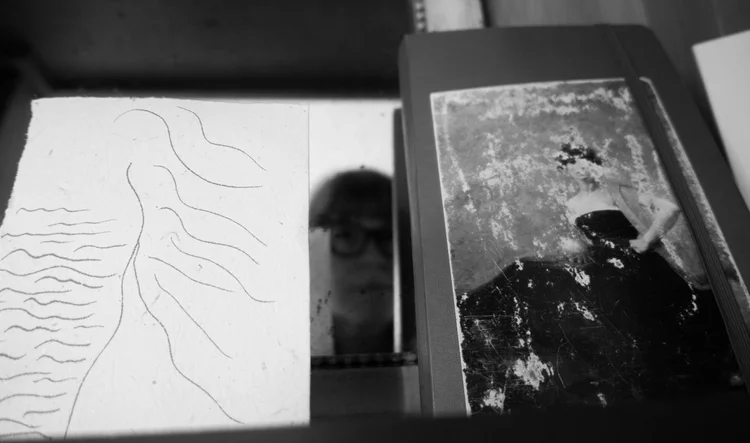
I have no conclusion to offer you, my friends. No beautiful ending to my relfections today. I have these two films on my mind: La double vie de Véronique and A Zone of Interest which probably no one else in the world have put together in a same piece of writing to tell you a story of yearned empathy. And maybe that’s my only solace, that I keep looking for my doubles through writing, creating bridges with literary translation, searching for meaning through photography, with imagination. Creating reflections where maybe you can also see yourself. Maybe for now, that is enough.
|
|
|
|
a definition of hope, Amsterdam (July 2023) |
|
|
|
WATCH
I really enjoyed watching American Fiction by Cord Jefferson, a film adapted from the book Erasure by Percival Everett (2001). It tells the story of Monk, a frustrated novelist who's fed up with the establishment that profits from Black entertainment that relies on tired and offensive tropes. To prove his point, he writes a book as expected of the White literary and media establishment to be “Black” under a pen name, and what unfolds is the whole hypocrisy of the system and the literary industry. Many moments I could imagine a version of this film set in the Netherlands, Belgium or France. Someday I may even write that version myself! LISTEN
The soundtrack of Krzysztof Kieślowski’s film La double vie de Véronique by composer Zbigniew Preisner. It is mesmerising. It will move you even more if you watch the film too. READ
Vanessa Springora’s memoir Le Consentement (which has been translated to English by Natasha Lehrer as Consent) is a very difficult read. I have dived into it (as well as in other literature about sexual abuse on minors) since actor Judith Godrèche has filed complaints against filmmaker Benoit Jacquot for rape with constraint, and another French auteur cinema favourite, Jacques Doillon for rape with violence. I wanted to write in a future issue of the newsletter about sexual abuse and abuse of power in art, cinema, literature, as it’s been bothering me for years (from Woody Allen to Roman Polanski and many more) but I haven’t found the strength yet to dive deep. It may come. In any case, Springora’s memoir is disturbing in the reality it describes and how the system has allowed all the abuse to happen, but it’s also an incredible reclaiming of one’s agency and I applaud the author for fighting back her abuser with the weapon he’s been using all his life to legitimise his predatorily behaviour: literature.
|
|
|
the novel’s editing sketchbook, May 2022 |
|
|
|
the novel’s editing sketchbook, May 2022 |
|
|
🧡 join my Patreon community for $3/month: I am developing a space where you can access behind the scenes content and where we can engage on the topics of the newsletter and have a conversation.
|
|
🎙️ an audio version of the attention span newsletter is available on your favourite podcast app: Spotify, Apple Podcasts, Overcast…or to listen on the attention span website.
|
|
ABOUT Canan “Ja’anan” Marasligil (she/they) is a writer, literary translator and artist based in Amsterdam. They established The Attention Span website and its newsletter to publish their work independently: making the time to reflect, analyse and imagine.
|
|
Thank you so much for reading! Feel free to share this newsletter with your friends, on your social media and more. Here’s the link to subscribe: theattentionspan.com/subscribe
When quoting or sharing content, make sure to attribute it to the author. Unless otherwise stated, all content (writing, photography, design) created and published in this newsletter is authored by me, Canan “Ja’anan” Marasligil.
|
|
|
|