|
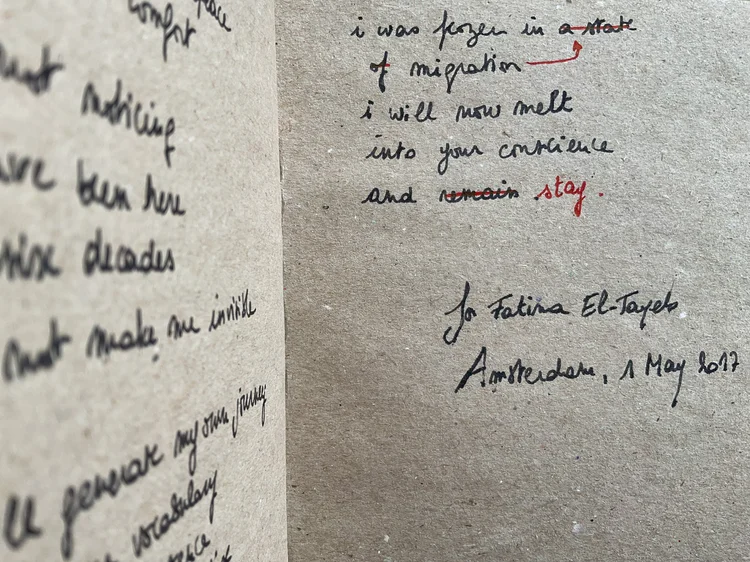
In 1978, documentary photographer Bertien van Manen, who was capturing the lives of female immigrant workers, photographed the first ever strike of Turkish women in the Netherlands at a chicken factory in Almelo. The women had to work eighty hours per week, were severely underpaid and underwent serious physical discomforts because they had to process the sizzling hot chicken meat with their bare hands. I first came across one of those photographs at ATRIA, the Institute on Gender Equality and Women's History in Amsterdam, in 2016. Five women stand in front of a banner that says “Turkish Women on Strike”, three of them wear a headscarf, including the one in the middle who is looking right into the camera. She’s the one who invited me into the moment. She has a powerful and tender gaze which, to me, represents far more than just the strike and carries many emotions, from pain to hope, of the history of Turkish immigration to Western Europe. A gaze, researcher and photographer Çiğdem Yüksel has been honouring in the past few years by conducting research about these women, reclaiming their position in the archive through their own voice and agency. On 14 May 2023, Turkish citizens are invited to the polls in an election that may bring significant change. Those of us with a Turkish passport living abroad have been able to cast our vote last week. In her poignant documentary Mijn Turkse Stem (My Turkish Vote/Voice), journalist Suzan Yücel tells her own story as a holder of both Turkish and Dutch nationalities, of how she moved away from voting for current president Recep Tayyip Erdoğan in the past, questioning her choice and its consequences in a country where she does not live. The film also recounts how her journey conflicted with her parents’ political views, who both still vote for the AKP leader. While triggered by many conservative views expressed in the documentary, I was moved by Suzan’s story and the love they carry for one another within her family. Despite their differences, they have worked towards a way not to polarize further. They have chosen to heal while going their own way and respecting one another. And yet, even though Yücel’s story offers some hope and understanding, the pain under remains palpable. Let me recount you my voting experience back in April 2017, when Turkish nationals were invited to vote in a referendum for the Constitutional amendment that transformed the system in Turkey into an executive presidency: In the immense congress centre turned into a Turkish polling place in Amsterdam – and where your parking ticket would be reimbursed, courtesy of the Turkish tax payers’ money – I saw this young woman standing in the middle of the gigantic ugly neon-lit greyish white room, dressed in a spectacular wedding gown, covered from head to toe in pristine white, her face enclosed with white satin, shining in perfect make-up. She was taming her fluffy skirt while her groom stood beside her in his pale blue tie and navy jacket. They were getting ready to have the happiest moment of their lives being immortalised on camera. They had chosen to make this instant in history and this insipid space a part of their union. I couldn’t help but think of a delusional Norma Desmond getting ready for her close-up in Sunset Boulevard. Except, we were not in Hollywood but a rather more menacing mise-en-scène of a democracy. As I was approaching one of the many polling stations surrounding the bride, I was greeted by two men who told me there needed to be three people to register me, “Hasan? Where is Hasan?” “He went to pray.” I moved to the next station, one eye still on the bride, trying to understand why she decided to perform her happiness in this ugliest imaginable space, where members of a nation were to decide if they would further normalise and consolidate the powers of a president on his road to authoritarianism. This performance was a demonstration of the relationship of people of Turkey with their state, and it disturbingly recalled what Umberto Eco has described as “Ur-Fascism”. The current regime had taken over all layers of Turkish society and confirmed its power over the past twenty years, replacing older forms of undemocratic practices many had escaped before that. My passport wasn’t enough to register my vote, they still asked for my Turkish ID, “it will be easier otherwise we need to ask your father’s name”, which was very handily printed at the back of my gender-specific pink ID, right next to my mother’s name, and the religion I was born into. This was the only place in Europe where neither my name nor my father’s – Abdullah – were frowned upon. I voted. I was offered a baklava on my way out, served on an immense aluminium plate – courtesy of the newlyweds. I exited the congress hall and jumped on my bike. Ten minutes later, I was at the Free University of Amsterdam listening to Judith Butler delivering a lecture on “Bodies that Still Matter”. The first thought that came to my mind while leaving the polling centre on that April day back in 2017 was: “I am not one of them”, certain that I was not lost among the polyphony of hateful discourses like they were. I quickly realised this very feeling made me fall into the same divisive narrative I thought I was critical of. Yes, the choice was one or the other – don’t all referenda create division among societies? – but the reasons behind any of these choices can be multiple. I had assumed the bride voted yes. She was celebrating after all, not only her marriage to her husband, but to her almighty-to-be powerful leader. Her choice was going to deny the existence of my fellow queer citizens, of my own deliberately child free existence, of journalists seeking the truth, of academics practising critical thinking, of artists and writers’ freedom to create, it will deny us all imagination. It pains me deeply to review these words I wrote six years ago, to see how much suffering has been perpetrated throughout those past years on all the communities I have just listed. On the 6th of May 2023, I went to vote for the general elections, this time with an ID card liberated from binary gender-coloured paperwork, back in the same congress centre where the bride took her wedding pictures six years ago. Is she still married to the man with the pale blue tie? Is she happy? Will she vote again in the same way? I approached the polling station all smiles, the young woman registering me had a nose piercing like me, she was enthusiastic and energetic. We exchanged laughs carrying our hope. I voted. Away from a country where I live but where my heart is strongly rooted. I find solace in defining myself as a “European Other” as described by Fatima El Tayeb in her 2004 book European Others, Queering Ethnicity in Postnational Europe. The women striking in Almelo, the researchers and the journalists, like Çiğdem Yüksel and Suzan Yücel reclaiming our voices and redefining what it means to be Europeans with Turkish descent, me creating the space to express my thoughts, we all reclaim the “otherness” which was imposed on us by contexts we live in. It brings me hope that our experiences can be recognised as complex and beyond binary definitions of identity. Our freedom and imagination have to be rooted in the possibility to heal.
|