|
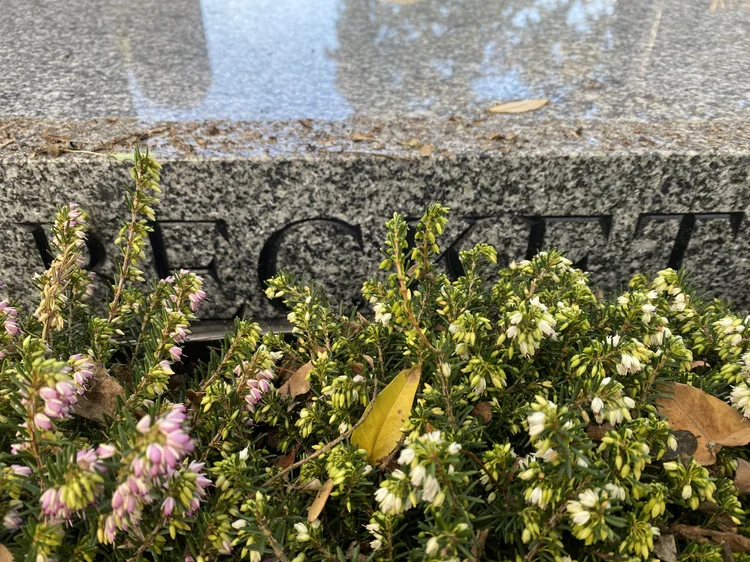
« Vous cherchez Beckett ? » The keeper in the Montparnasse Cemetery asked if I was looking for Beckett. I answered yes. « Je me disais bien, dans cette allée c’est le plus connu. Vous êtes passée devant. Il est là. » He said pointing me to Beckett who was the most famous of all the departed buried in this alley. I had walked past without seeing him, « c’est parce qu’il y’a les fleurs devant. » Beckett was hiding behind the flowers. I thanked the cemetery keeper and approached the tomb, touched it, as well as the flowers. I was on my way to the city of Tours, via Paris, and had to change trains in Montparnasse. I couldn’t think of any better way to spend the couple of free hours I had than to walk to the cemetery to see Samuel Beckett. Earlier in the busy metro, a woman I had given my seat to insisted that I return next to her the moment the seat on her side got free again. She then offered me some chocolate. It was one of those with fruit inside, which I usually don’t like. But I obliged. I was moved by her kindness. The dark chocolate with orange inside even tasted sweet. We talked from Les Halles to Odéon. She said that she was on her way to the dentist who was getting richer every time she went to see him to get a tooth fixed. No wonder he could afford an office in Saint-Germain des Prés, she added. Next to all the fancy publishers many of the writers and translators I love have no access to, I thought. She asked if I liked the chocolate, I nodded. She stepped out at Odéon, waved me goodbye from the door. I watched her frail body wrapped in an electric blue puffy jacket as she disappeared behind the crowd. She was carrying a sense of bitterness mixed with joy. Just like the chocolate we shared. I’ve been thinking about these encounters a lot recently, especially in the light of conversations I had with people I work with or befriend, as well as things I read, on the state of culture in the current socio-economic, political and cultural contexts. Posts from fellow artists, writers and cultural programme makers on creating in times when public funding becomes scarcer, and in some places is even non-existent if your politics don’t allign with those of the government. Nobody creates nor engages with artistic content in a vacuum. I am interested in exploring what it means when we create – whether we write, make art or films, or we open (or close) the gates for these creations to meet with people. What happens when our role is one of a so-called gatekeeper, i.e., when we get power in the cultural hiearchy to make space for works to be experienced by a public? We are often pushed in one way or another to put the people we define as “audiences” in certain boxes (age, cultural affinities, communities, interests, geographic reach, education etc.) These categories in turn define how artistic creations of any kind are being presented and made “accessible”. But who am I to decide if the cemetery worker would go to see a play by Beckett or not for instance? Or if the woman in the metro would see an exhibition or attend a literary talk? Regardless of who we are, how much we earn, what our understanding and expectations are from Culture, don’t we all have a right to access it without any financial, physical or psychological obstacles? And what is Culture? To me, the encounters I described earlier are part of culture, and maybe turning them into this newsletter makes them indeed a piece of reflection and imagination that is part of my writing practice which we may file under art or literature. But beyond that, it is also a part of my understanding of what has been coined by many cultural organisations as “audience development”, an ugly vocabulary which has commodified connection between art and people, just like art in general is being commodified at a scary pace even in countries where public funding was always supposed to allow experimentation and creativity outside of formats dictated by platforms of promotion and presentation. A recent cry out against such commodification came from this year’s Palme d’Or winner Justine Triet, who, after her thank you’s mentioned the protest movement against the pension reforms in France and how it was denied and suppressed in a shocking manner, linking it to how this kind of power was also present in different areas, such as the film industry, and how such practices led to a commodification of culture. Two years ago, from another angle, Martin Scorcese had highlighted how problematic the commodification of cinema was, in an essay published in Harper’s Bazaar. Triet’s statement didn’t surprise me one bit, I keep seeing this happening over and over across sectors – literature is no different for instance, and the less there is space for makers to create freely the less incentive there will also be to connect these works to people to feel, enjoy, reflect, think etc. The many reactions against Triet started with France Culture Minister Rima Abdul Malak who reacted on Twitter that she was “flabbergasted” by how unfair Triet’s speech was, adding that “This film wouldn’t have seen the light of day without our French model of film financing which allows for a unique diversity in the world. Let’s not forget it.” This proved exactly Triet’s point about power. And it’s a worrying state culture has been pushed into by neoliberal governance in many countries. What do we do if there is no money to fund all sorts of arts and culture? And how are the people who create the connections between works of art and their audiences supposed to work if the only way we measure “success” is through numbers: audience numbers (online and in real live) which links to higher financial gain. I don’t want to think about how many people will show up at an event or how much money we will earn when I curate a cultural programme or when I write or make art, I want to focus on the possibility of an encounter. The magic that will happen between people when they engage with one another, through the imagination of someone who happened to make something beautiful. To taste the bitterness of fruit mixed with dark chocolate and still feel you can feel someone else’s existence and reality, even for a short instant. None of these negate the need to connect with more people and to fill our theatres, libraries and exhibition halls with as many as possible, the main difference, though, is the incentive with which we create and that should never be rooted on any number.
|