|
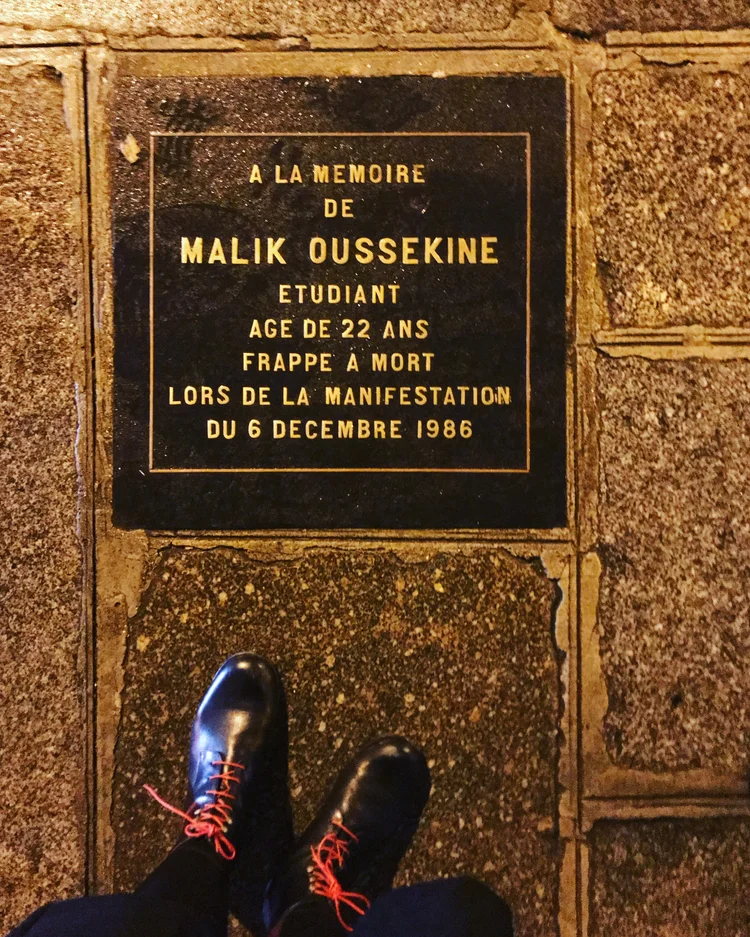
It is impossible not to think about violence right now. I don’t think it ever was. As a multilingual being in this world, I find no respite from any of the world’s current events. Even if I tried to ignore certain news, at some point, they appear in my online feeds or conversations, in one language or another. And I translate these constantly in my mind, as a way of understanding why it happens. Language has this effect on me: it creates the illusion that it might change not only the way we see the world but how we act in it, and how to (re)imagine it. I write illusion because right now, I feel language fails me. Right now, the killing by a police officer of seventeen-year-old Nahel is on my mind, the fact that it is not an isolated act of violence. I will not repeat the existing research and experience on systemic violence against people of colour within the police. Instead, I want to look at memory and how erasing parts of history leads us here. How that, in itself, is an act of violence already. Let me travel back to Algeria, where I went for the first time in 2011 to attend the International Comics Festival of Algiers (FIBDA), where I learned about the Paris massacre of 1961 for the first time through the work of comics artist Abbas Kébir Benyoucef 17 octobre 1961, 17 bulles : tragédie sur Seine which was exhibited there. I was shocked that such extreme violence occurred at a time so close to my own contemporaneity, in a city that felt close to me through language: French, and all the cultural references surrounding it. In French-speaking Belgium, we were closer to France than to our Flemish co-citizens. This closeness didn’t go as far as into history books. Not knowing about the mass killing of Parisian Algerians by the French National Police was another layer of violence I was yet unaware of back in school. Erasure of history is violence. “It occurred on 17 October 1961, during the Algerian War (1954–62),” the massacre’s Wikipedia article says, and continues: “Under orders from the head of the Parisian police, Maurice Papon, the National Police attacked a demonstration by thirty thousand pro-National Liberation Front (FLN) Algerians. After 37 years of denial and censorship of the press, in 1998 the government finally acknowledged 40 deaths, while some historians estimate that between 200 and 300 Algerians died. Death was due to heavy-handed beating by the police, as well as mass drownings, as police officers threw demonstrators into the river Seine.” That I learned about this murderous event fifty years later, not in France but in Algeria, in a graphic novel created by an Algerian artist, should not surprise me. Institutions keep failing us, the only way to reclaim our stories and our truth, is to take the space to tell our (his)tory. Eight years after my first Algerian trip (I went back twice in the following years), I was walking the streets of Paris – flaneusing as I always love doing and came across a street memorial at a spot where a young Algerian student got beaten to death by the police during demonstrations that happened in 1986. His name was Malik Oussekine. Another murder I did not know about. This time though, I learned about it in the city where it happened, walking by a commemorative plaque on the sidewalk. It was put there in 2006, twenty years after Oussekine got killed, one year after the so-called “2005 riots” which was ignited by the deaths of two teenagers electrocuted in a power substation while fleeing from the police. The commemorating plaque in memory of Malik Oussekine wasn’t put there without controversy. First, there’s been discussions about naming the perpetrators: the police. Then, the location of the plaque, which was supposed to be on the wall but ended up on the sidewalk, because the owners were worried about the logistical aspects and the “aesthetics” of their building. They were more concerned with reputation than commemoration. Another act of violence. I keep wondering about language. I spent the weekend in Brussels at my mom’s house, where Turkish television prevails. Most news channels were constantly covering what is currently happening in France, and discussion programmes are analysing the systemic racism of the country, how it all led to killing a seventeen-year-old and how a white kid would have never been shot this way. I was reliving the news in my mother tongue, and it continued shaking me only from a different bone. And I am writing about it in English, here. Translating it all in my mind I still find myself without a discourse. I am lost and am trying to make sense of this violence through language and feel incapable of it. Language fails me, yet language is all I have. When she was living in California, poet and painter Etel Adnan, who was then writing in French, was following the Algerian War of Independence closely, understanding the violence language carried in this colonial context. This crucial development in her writing and artistic practice led to a shift to writing literary texts and poetry mainly in English. But most importantly, she found freedom in colour, which was “a free language, not influenced by colonial powers but pure and from the heart,” as Sara Tas, curator of Adnan’s exhibition Colour as Language which took place in 2022 at the Van Gogh Museum, explains in the catalogue. I love how Adnan was seeking beauty through colour and created her own language this way, despite how heavy the world was, and as we see, still is. So maybe language doesn’t completely fail me. After all, I am writing this newsletter and am connecting with you all. Your presence matters to me, and so does my own. In this collective experience of our wounded world, I trust we will find our own language to eventually repair, and heal.
|