|
THE ATTENTION SPAN a monthly invitation for reflection, analysis and imagination by writer, literary translator and artist, canan marasligil. issue 37|san francisco diary (part 3) read part 1 and part
|
issue 37|san francisco diary (part 3)
|
|
|
|
Chinatown through my grandmother’s lens, San Francisco, February 2025 |
|
|
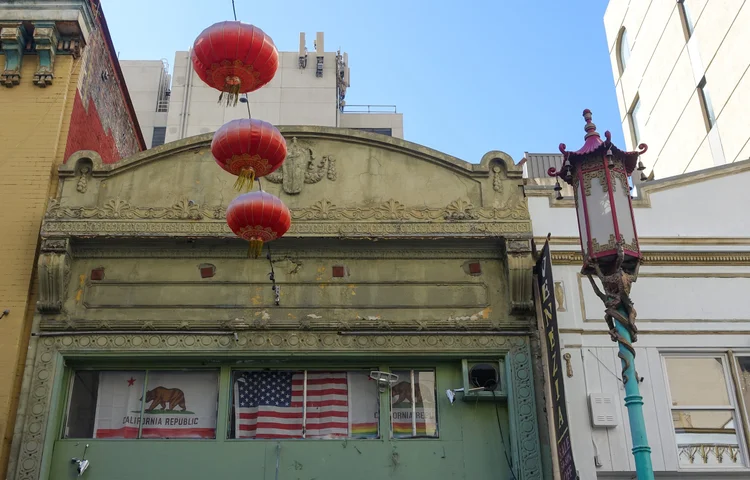
I took grandma’s analogue camera with me during my flaneûsing in Chinatown. I know she would have loved to see this place, more than any other in San Francisco. The architecture and the colours are so iconic, inviting, mesmerizing, they’ve haunted our imagination through so many films, books, postcards and more. Even as so-called orientals we can fall for orientalism, no matter how much we ourselves are victims of the Western gaze we seek to reject. But maybe it isn’t as much a repetition of the same gaze; maybe we’re not exoticising but instead seek recognition and resemblance? I grab grandma’s camera from the bottom of my newly bought City Lights Bookstore tote bag, right behind the corner of Jack Kerouac alleyway connecting Chinatown to North Beach via Columbus avenue. I only take one photograph with her camera, and it captures life in-between: both the STOP and FOR SALE signs are cut off, laundry is hanging on the balcony, and a red parasol is offering some shade to an invisible inhabitant. The grain created by analogue film creates the illusion of an ancient photograph, one grandma could have taken herself had she visited this place thirty or fourty years ago. Flaneusing in Chinatown I realise this place is many definitions of translation, all the definitions I have been developing in my practice manifesting through the emotions of this place.
|
|
|
|
Chinatown, San Francisco, February 2025 |
|
|
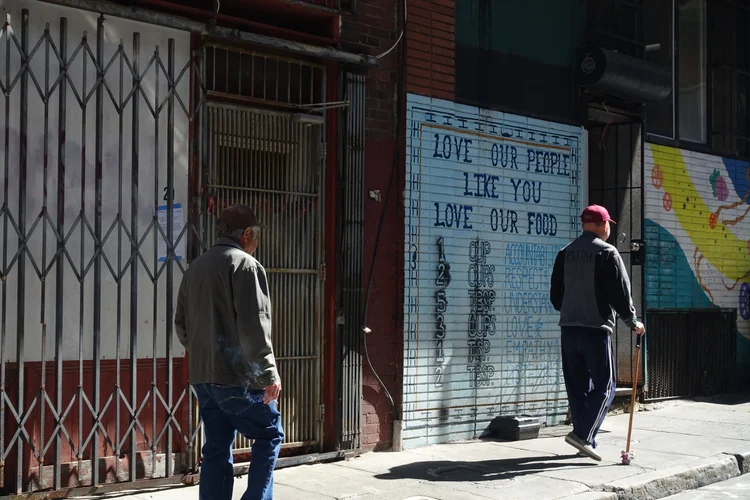
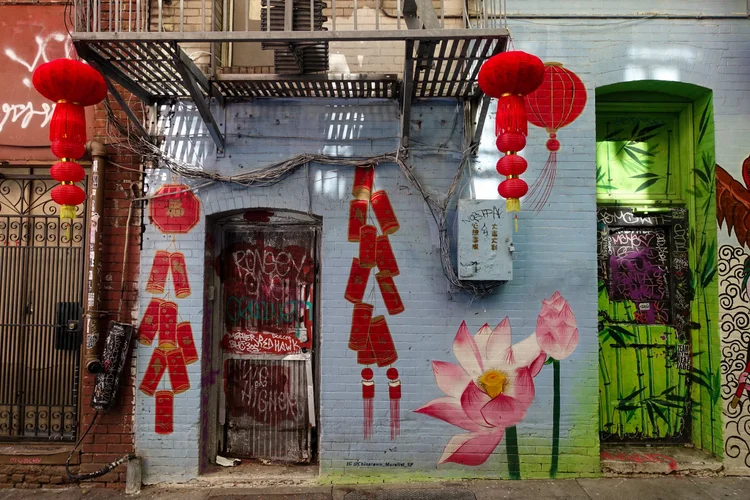
LOVE OUR PEOPLE LIKE YOU LOVE OUR FOOD the mural says, listing the elements needed in the manner of ingredients in a recipe: accountability, respect, understanding, love, empathy and listening. Produced by the Mandarin Institute and artist Vida Kuang in 2021, the mural is a call to action for people to examine how they’ve consumed Asian food and culture, and actively acknowledge the labour, history and colonization of Asian peoples. “Love our people like you love our food” is a recipe for solidarity. It includes all the ingredients for translation. My Chinatown wanderings happened to coincide with an online workshop I was going to give the next day to young translators, and this particular mural, together with other encounters I made here, found there way into my teaching.
|
|
|
|
Chinatown, San Francisco, February 2025 |
|
|
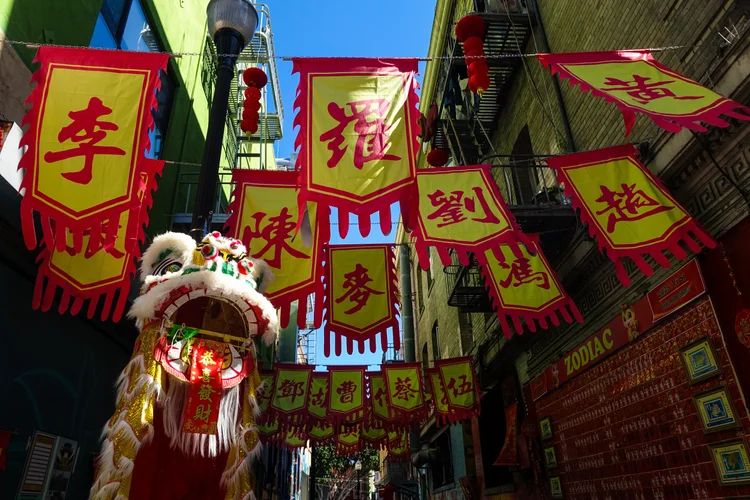
The first immigrants from China arrived to California in the 1840s. The Chinese people of San Francisco faced conflict and resistance from the Americans for a long time. Sinophobia raged high in the community in the 19th century, which even led to the banning of Chinese immigration in 1882, and continued well into the 20th century. San Francisco tried to destroy Chinatown many times throughout history. The architecture of Chinatown is a response against the city’s attempt to move Chinatown after the 1906 Earthquake. Merchants developed a plan to rebuild Chinatown into an “Oriental City”against the threat of displacement. That is why Grant Avenue is lined with classical building elements combined with Chinese motifs. As the Chinese Historical Society of America explains, “the use of green, yellow, and red are authentically Chinese, but overall, the architecture you see today is unique only to San Francisco.” I had no idea that it is politics of exclusion that had influenced the architecture of Chinatown. Discrimination and government policies kept the Chinese constricted to a small area at the western edge of the central business district. The Chinese people were banned from owning property by the State of California and were left to the mercy of the American landlords. The lack of space led to the formation of hybrid residential and commercial buildings in every space leftover in the city, creating a crowded and densely populated urban area.
|
|
|
|
Jack Kerouac Alley, San Francisco, February 2025 |
|
|
As a translator I cannot help but see this act as a refusal to translate in order to survive, exoticising your own existence to stay alive. It is disturbing and brilliant, it is a recognizable feature of any “outsider” to a society with existing codes who would be forced to code-switch constantly to be able to “fit in”, except that here, the population did the exact opposite. Almost 200 years since the first immigrants came to California from China, the place is very much alive and filled with people with roots in Asia.
|
Say translation at the edges of perception, say do you really want to be defined by your limitations translation. Say aesthetics over politics translation, say politics over aesthetics translation. Say nation state translation, say I’m over that nation state translation. Say back translation from the colonial language original to the home language translation, writing in a colonial language already a translation before having been written at all (YS). Say treacherous translation, translation both pointing out the gulf and trying to bridge the distance (SBS). Say I refuse to translate (DMC). Say I’m not here just to close the distance translation.
|
|
With references to Yi Sang, Serk-Bae Suh and Don Mee Choi, in her manifesto Say Translation is Art, poet and translator Sawako Nakayasu expresses exactly what such refusal to translate encompasses.
|
|
|
|
Chinatown, San Francisco, February 2025 |
|
|
It is not surprising that my next encounters in Chinatown have been with a series of Asian American queer artists exhibiting at Edge on the Square, a contemporary art hub on Grant avenue, in an exhibition titled Walking Stories which was co-presented with Asian Americans for Civil Rights & Equality (AACRE). Walking Stories examines how human behavior can be viewed as a collection of narratives, with individuals perceived as walking embodiments of stories. These stories are carried within the storyteller and passed down through generations, constantly evolving as they are shared, modified, and adapted according to circumstance, context, and audience. The exhibition explores the ways in which we carry, give, receive, and exchange stories. Historically, storytellers such as jongleurs and Pingshu artists have played significant roles in highlighting key aspects of human experience, aiding our understanding of the past, and navigating the present. The stories told reveal important truths about reality, identity formation, and human behavior. Both personal and political, some stories have perpetuated segregation, racism, and sexism, while others envision equitable futures by imagining new worlds. The artists Alice Wu, Dohee Lee, Farhana Sobhan, Hana Luna Her, Katie Quan, Kaori Furusawa, Lydia Nakashima Degarrod, Manon Wada, Mark Hellar, Mia Nakano, Miko Lee, Related Tactics, Trần Châu Hà, and Tsim Nui Vang explore these themes in their multimedia practices through interactive installations, video, performance, photography, zines, and conceptual potlucks. The artists investigate prevailing narratives and their implications, prioritizing stories that foster interconnectedness, empathy, and active engagement with the world around us. As both individual and collective “walking stories,” every story we create influences and shapes us, and in turn, we continue to shape the world.
|
|
|
|
Chinatown, San Francisco, February 2025 |
|
|
Where is your place in the RESISTANCE? by Farhana Sobhan Shama is a painting that represents the various resistances and movements currently occurring throughout Asia as documented by Alliance of South Asians Taking Action (ASATA). Farhana conducted conversations with over 30 Southeast Asian activists about their experiences and efforts in community organizing, liberation, personal reconciliation, and solidarity. These conversations have been synthesized into images and symbols which form concentric rings emanating from the iconic watermelon, the symbol of Palestinian solidarity. Each concentric ring contains icons symbolizing a different resistance movement that is unique to South Asia. Recentering these communities, beginning with Palestine, spotlights those which are often left in the shadows and unseen, bridging together the connections that exist between all resistance movements, both abroad and at home. I have showed this painting in my online class with the translators the next day, asking everyone to draw their own circle and place their translation practice within various contexts and stories they find themselves in.
|
|
|
|
Where is your place in the RESISTANCE? by Farhana Sobhan Shama |
|
|
I was also very moved by Miko Lee’s installation titled First Dragon and Descendants. During the course of the Covid lockdown, working on self care to deal with family trauma, Miko Lee reflected on the legacy of being a fifth-generation Chinese American. Miko discovered a faded photo of her great, great grandfather from family immigration papers from 1892, with scrawled marks that read, “3 visible scars on both sides of face.” Inspired by this imagery, Miko began outlining his face and embroidered his imagined portrait. With scars on both sides of face, Miko imagined her great, great grandfather as the Monkey King, travelling across the world, bravely and mischievously facing many adversities. Comparable to the way in which the Monkey King had pulled out his hair to create many more monkeys in his own image, Miko used family photos to embody more of her ancestors on silk: a great grandfather who build the railroads, an auntie who died in the hand laundry, a grandma who made soy sauce for San Francisco Chinatown, a great grandpa who mined for gold, a grandma who integrated Burlingame and ran a restaurant, a dad, professor and minister who marched with Dr. King, a mom who was a community organizer. Miko’s family genealogy covers over thirty-three generations: beginning with “First Dragon” in 837 AD, who settled in Flower Country, with a cover that reads: “Tracing Afar Cautious Forever.” Woven into delicate diaphanous silk, Miko weaves together the threads and intersections of her contemporary narrative into her family history. By stitching together her past, she attempts to make sense of her future.
|
|
|
|
Zine and installation by Katie Quan of REALSOUL |
|
|
I pick a fortune cookie made of purple felt from the installation Nourishing Power by Related Tactics with Mia Nakano. Drawing inspiration from the role potlucks have played within queer Asian American social justice groups as a site of connection, Nourishing Power offers an array of takeaway tools for gathering (prompts, objects, recipes for action, questions) that audiences can carry into the world and enact. Like a potluck, these tools will encourage people to bring something to share with their gatherings to sustain and nourish interconnectivity and empathy. The project features contributions from Joey Enríquez, Heather Hart, Elokin Orton-Cheung, Sun Park, Tina Villadolid, Kit Yan, and victor yañez-lazcano, alongside Related Tactics and Visibility Project.
|
|
|
|
Chinatown, San Francisco, February 2025 |
|
|
I step out of the exhibition with the purple fortune cookie in my palm, I open it in front of the Bruce Lee mural: “What parts of your identity do you feel are closeted?” the piece of paper gazes back at me. I observe the resilience of the Chinese American population in the colours of my surroundings, every brick a confirmation of their pain and joy, their strength and pride. I feel inspired by the Asian American artists’ work I just saw. Translation is my closet and my liberation. Chinatown shows me how translation and the refusal to translate are not only a matter of survival, but also an act of self-expression and self-acceptance. I go back to Sawako Nakayasu: “Say I’m not here just to close the distance translation”.
|
|
|
|
A recipe for translation, San Francisco, February 2025 |
|
|
🔜 stay tuned for the fourth (and last) part of my San Francisco diary, which I will send in two weeks (on 16 April 2025) instead of waiting until next month. I hope you enjoy it 💛
|
|
A FEW THINGS THAT MAKE ME THINK AND FEEL…
|
I have watched MO on Netflix, a two-seasons series telling the story of Mo Najjar a Palestinian refugee constantly living one step away from asylum on the path to U.S. citizenship. It is heartwarming, funny, silly, humbling, tender, eye-opening… you can feel it has been written and made out of love. MO was created by Mohammed Amer, who also stars in the show, and Ramy Youssef.
As I will soon travel to Jakarta and Bali, I am finally diving into David van Reybrouck’s Revolusi: Indonesia and the Birth of the Modern World, an extraordinary book of 656 pages showing how Indonesia’s struggle for independence is one of the defining events of the twentieth century. It has been translated into numerous languages (into English by David Colmer and David McKay). I could easily read the Dutch version, but I have chosen to read the French translation by Philippe Noble and Isabelle Rosselin, because I need some distance from the Dutch language when diving into this deep and complex history (something I may write about in a future issue of this newsletter).
In February 2025, Francesca Albanese, international lawyer and academic, UN Special Rapporteur on the Occupied Palestinian Territories was visiting a series of European countries, and while in Norway she spoke to Palestinapodden. You can listen to the episode, which was published on 23 February. This is where I learned that the role of UN rapporteur is voluntary. I already had a lot of respect for all her work, but with all the backlash she gets, a family of her own to feed, and a difficult economy for many, I find it even more powerful that she keeps doing the amazing work she does (with support of her husband, like she says. It does take love and community to do the work indeed!)
|
|
ABOUT + SUPPORT Canan Marasligil (she/they) is a writer, literary translator and artist based in Amsterdam. She established the attention span website and its newsletter to publish their work independently: making the time to reflect, analyse and imagine. thank you so much for reading! you can support the attention span by contributing as much as you’d like between 2,50 € and 25 € via this pay pal link.
|
|
Sharing is loving 🖤 Here’s the link to subscribe: theattentionspan.com/subscribe
When quoting or sharing content, please credit the author. Unless otherwise stated, all content (writing, photography, design) created and published in this newsletter is authored by Canan Marasligil.
|
|
|
|