|
Welcome to issue twelve of The Attention Span Newsletter by me, Canan “Ja’anan” Marasligil.͏ ͏ ͏ ͏ ͏ ͏ ͏ ͏ ͏ ͏ ͏ ͏ ͏ ͏ ͏ ͏ ͏ ͏ ͏ ͏ ͏ ͏ ͏ ͏ ͏ ͏ ͏ ͏ ͏ ͏ ͏ ͏ ͏ ͏ ͏ ͏ ͏ ͏ ͏ ͏ ͏ ͏ ͏ ͏ ͏ ͏ ͏ ͏ ͏ ͏ ͏ ͏ ͏ ͏ ͏ ͏ ͏ ͏ ͏ ͏ ͏ ͏ ͏ ͏ ͏ ͏ ͏ ͏ ͏ ͏ ͏ ͏ ͏ ͏ ͏ ͏ ͏ ͏ ͏ ͏ ͏ ͏ ͏ ͏ ͏ ͏ ͏ ͏ ͏ ͏ ͏ ͏ ͏ ͏ ͏ ͏ ͏ ͏ ͏ ͏ ͏ ͏ ͏ ͏ ͏ ͏ ͏ ͏ ͏ ͏ ͏ ͏ ͏ ͏ ͏ ͏ ͏ ͏ ͏ ͏ ͏ ͏ ͏ ͏ ͏ ͏ ͏ ͏ ͏ ͏ ͏ ͏ ͏ ͏ ͏ ͏ ͏ ͏ ͏ ͏ ͏ ͏ ͏ ͏ ͏ ͏ ͏ ͏ ͏ ͏ ͏ ͏ ͏ ͏ ͏ ͏ ͏ ͏ ͏ ͏ ͏ ͏ ͏ ͏ ͏ ͏ ͏ ͏ ͏ ͏ ͏ ͏ ͏ ͏ ͏ ͏ ͏ ͏ ͏ ͏ ͏ ͏ ͏ ͏ ͏ ͏ ͏ ͏ ͏ ͏ ͏ ͏ ͏ ͏ ͏ ͏ ͏ ͏ ͏ ͏ ͏ ͏ ͏ ͏ ͏ ͏ ͏ ͏ ͏ ͏ ͏ ͏ ͏ ͏ ͏ ͏ ͏ ͏ ͏ ͏ ͏ ͏ ͏ ͏ ͏ ͏ ͏ ͏ ͏ ͏ ͏ ͏ ͏ ͏ ͏ ͏ ͏ ͏ ͏ ͏ ͏ ͏ ͏ ͏ ͏ ͏ ͏ ͏ ͏ ͏ ͏ ͏ ͏ ͏ ͏
|
#12 / the beauty of impermanence
|
|
Welcome to issue twelve of The Attention Span Newsletter by me, Canan “Ja’anan” Marasligil. I’m a writer, a literary translator, an artist and a curator of cultural programmes based in Amsterdam. Every other week, I take the time to reflect and offer a glimpse of how I see and feel the world through the lens of culture, art, translation, poetry and literature. If you prefer an audio experience, you can listen to me reading the newsletter to you. I also invite you to support my work via Patreon. Thank you for your presence and attention!
|
|
THE ESSAY: THE BEAUTY OF IMPERMANENCE (ON ETEL ADNAN)
|
|
Last summer, I wrote an essay on Etel Adnan for the Poëziekrant (translated to Dutch by Martine Wezenbeek), and my heart just told me that today is a good day to share the original English version with you. I have made a selection of photographs to accompany your reading, and the essay includes a list of references including writing and audiovisual material. My usual reading/watching/listening list, notes on translation and sketchbook page have been incorporated into this essay as accompanying resources that I hope will feed your thoughts, heart and soul.
|
|
|
|
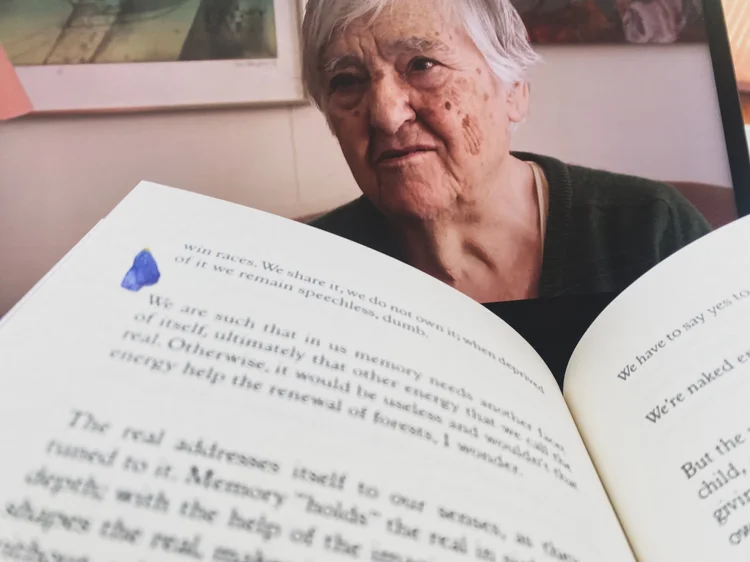
Etel’s flower petal (May 2023) |
|
|
|
Etel Adnan’s poetry books are placed in my library in Amsterdam, in front of a futuristic version of my home city of Brussels as reimagined by artist François Schuiten. Nothing more than le hasard, the randomness that sometimes guide our lives, which Adnan was fond of. The poet and artist also valued dialogue and connection with her work, and encouraged it in others too, as she once told then assistant editor Dominique Eddé at the newspaper El Safa in Lebanon where Adnan was culture editor in the seventies, to “write about Picasso and Umm Kulthum in the same article if you feel the need to.” I therefore suspect she would have enjoyed this conversation her work had started in a corner of my chosen home. As I open Adnan’s poetry collection Surge, I find a flower petal I had stored inside, a gesture I often do as a way to preserve or to archive life. The tiny purple petal has found its way to the following verses: We are such that in us memory needs another facet of itself, ultimately that other energy that we call the real. Otherwise, it would be useless and wouldn’t that energy help the renewal of forests, I wonder.
Etel Adnan’s work encapsulates ongoing wonder and a search for beauty in a world filled with violence and injustice. Throughout her oeuvre and in her numerous interviews, one understands that despite all the horrors and the divisions created by wars and conflict, many of which she has seen from within as well as from afar, Adnan agreed to accept the world as it is. But acceptance doesn’t equate torpor. The world demands us to respond, she tells Ricardo Karam, “while problems destroy, they also sustain us,” she says, adding that fighting gives energy, “it is a reason to live” and “we have to move forward, there is no other choice.” Etel Adnan was born in Beirut in 1925 to a Greek Orthodox mother from Smyrna (today’s Izmir in Turkey), a city that was burned to disappearance in 1922, and a Syrian Muslim father, a high-ranking ottoman officer who was a classmate of Mustafa Kemal Atatürk, the founder of modern Turkey. Sharing a geography and a part of my own history with Adnan is a connection I cautiously nurture because I also understand that having roots in places where chaos has been predominent has its weight, and thinking beyond simplified identities becomes not only a necessity but an urgency.
|
|
|
|
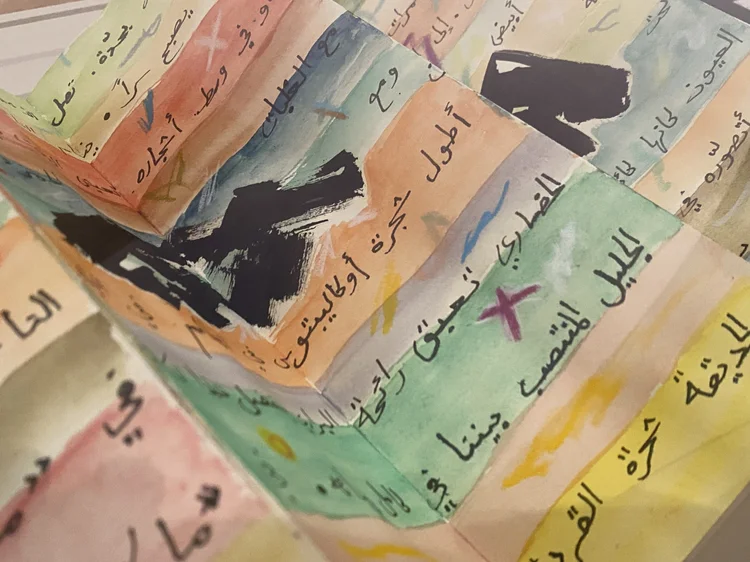
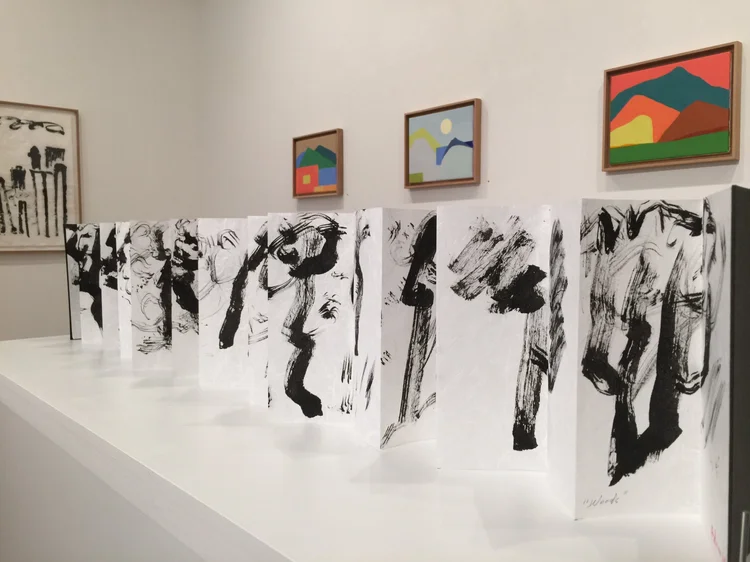
Etel Adnan, Journey to Mount Tamalpais (Rihla ilã Jabal Tamalpais), leporello photographed at the Van Gogh Museum Amsterdam (May 2022) |
|
|
|
Etel Adnan started writing poetry in French, which had become her primary language upon enrolling in a French convent school as a child. Her first work of poetry was a long poem she titled Le Livre de la Mer (The Book of the Sea) “a poem which sees the interrelation between the sun and the sea as a kind of cosmic eroticism.” At home, she spoke Greek with her mother and Turkish with her father. Arabic was a language associated with shame and sin in the French mandate-run Beirut Adnan grew up in. Although her books were translated into Arabic, it was never the language the poet used as one of her writing tools to create her own poetry. Adnan knew very well what it means to inherit language. Hers came with heavy historical and political baggage. With her restless pursuit for beauty and a rooted belief in acceptance and forgiveness, she reclaimed Arabic in her own terms: “I soon realized that to me this meant a new language and a solution to my dilemma: I didn’t need to write in French anymore, I was going to paint in Arabic.” She started painting in the 1960s in California where she was teaching philosophy of art, from where she was following the Algerian War of Independence closely, understanding the violence language carried in this colonial context. This crucial development in her writing and artistic practice led to a shift to writing literary texts and poetry mainly in English. Colour, on the other hand, was “a free language, not influenced by colonial powers but pure and from the heart.”
|
|
|
|
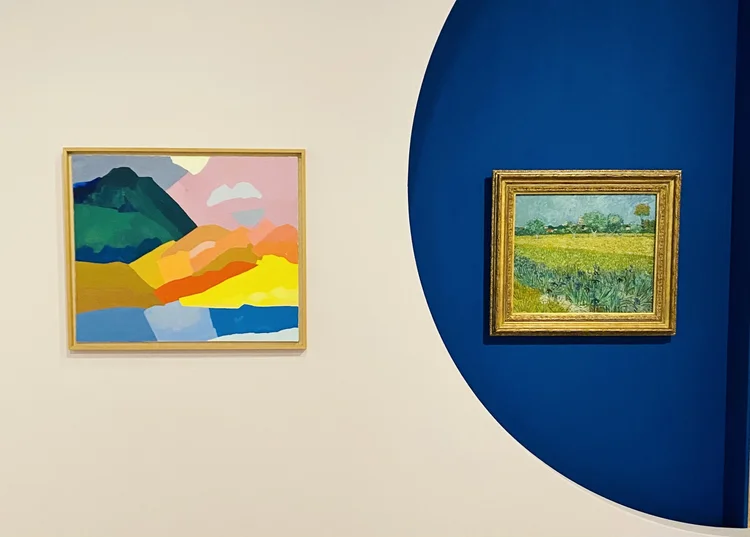
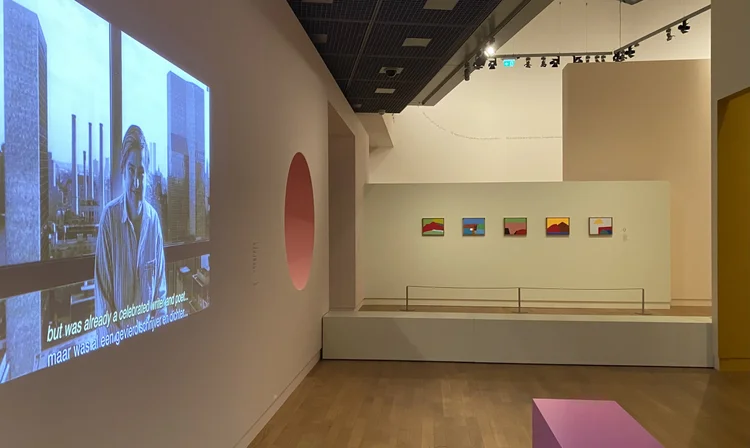
Colour as Language. Etel Adnan/Vincent Van Gogh (May 2022) |
|
|
|
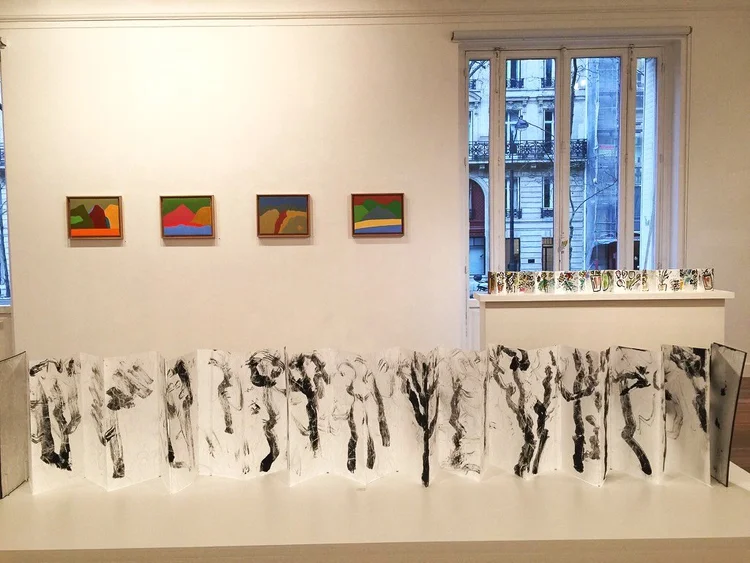
With colours and lines, Adnan created a new vocabulary, which she used to paint abstract oil paintings, create tapestries and leporellos where all gestures: writing, poetry, drawing and painting came together in all the languages of her life. It is not surprising that between May and September 2022, the Van Gogh Museum in Amsterdam dedicated an exhibition to Etel Adnan, titled, Colour as Language. Like a devout pilgrim, I was the first to enter the exhibition rooms at nine in the morning on the day it opened to the public, alone the first half an hour, perusing the colours, shapes, words and lines. I inhabited this retrospective of Etel Adnan’s languages in decades of work “dictated by emotions and events.” I met her beloved mountain Tamalpais through the multiple homages in watercolour, ink, oil paint and in writing she made. A point of reference during the forty years she spent in California, seeing it from her window, the mountain became a definition of home for Adnan. It was also one example of her deep connection to nature, observing its impermanence that reminded her of our own as humanity. As I walked among known works and those I was discovering for the first time, I hung around the leporellos in which she had copied verses of Arabic poetry, which I had first seen in Paris back in 2015, another small pilgrimage I did at the time, to the Galerie Lelong. I had naively peeked at the price list back then, I am pleased that today, many of Etel Adnan’s works are in museums for the general public to be able to feel and experience.
|
|
|
|
Etel Adnan at the Galerie Lelong in Paris (March 2015) |
|
|
|
It was always important for Adnan that her writing, poetry and art remain conversations, as she didn’t believe in creating work for oneself. Her love for architecture was a perfect example of this ongoing exchange between people and art, as well as the importance for beauty to be accessible for all. From cultural journalism, filmmaking to theatre, Adnan touched on many art forms to express emotions, and continue resisting the world’s pain and suffering with beauty. She had contemplated becoming an architect when younger, only to be shut down by her mother who told her it was a man’s job and how dared she even think about it. This didn’t stop her to dream a house she could build, with a room for every art field: a room for poetry, a room for films, one for painting and so on. She had a fascination for architecture which she saw as a social art, a gift to the public no matter who you are. Adnan didn’t care for classifications. Writer Dominique Eddé offers a sharp analysis as to why Etel Adnan’s art took so long to gain global recognition: Success came late because she was a woman and because she was ahead of her time. But also because she could not be pigeonholed. If her success is now global, it is probably because the world is discovering the limitations of “classification”, because it is suffering from the ills that Etel had explored fully before anyone else.
|
|
|
|
Etel Adnan at the Van Gogh Museum Amsterdam (May 2022) |
|
|
|
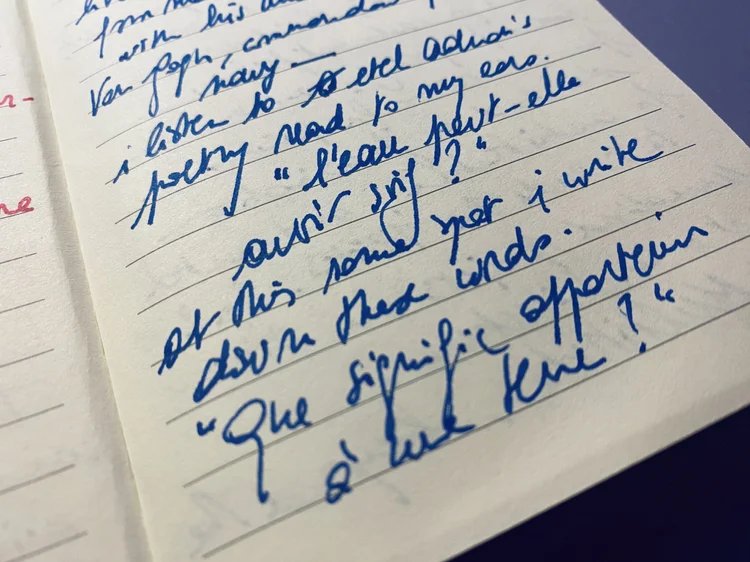
“L’eau peut-elle avoir soif ?” I stop by the flowers planted in honour of Van Gogh by a wall of the Marineterrein in Amsterdam, where the painter lived from May 1877 to July 1878 with his uncle who was commandant in the navy. I stop to write down this line I just heard listening to a podcast episode of an homage in French to Etel Adnan. I translate it quickly as I walk by this memory of the painter engraved in public space. “Can water be thirsty?” I draw the verse in my notebook with my fountain pen, “you can read someone through their handwriting,” Adnan once said, “it’s a photography of our soul.” I look up at the flowers reminiscing the painter whose work Adnan had first encountered in the 1950s in Paris, “Van Gogh’s drawing is not drawing, more writing, because he follows a rhythm more than a meaning.” Another line read in French transpierces my ears “Que signifie appartenir à une terre ?” I write it down too, but my handwriting is now more shaky, almost nervous. I can’t translate it on the spot. I return home to look up the exact verses from the collection Sea & Fog: What does it mean to belong to a land? For those of us who live away from our private history, the question never heals.
|
|
|
|
Notebook entry (13 May 2023) |
|
|
|
Whether using a pen, a palet knife –which she preferred to brushes when painting, pastels, ink, paper, a canvas or a leporello, Etel Adnan allowed the material to guide her poetic and artistic expression. Her responses to “the weight of the world”, to echo one of her beautiful series, have been an invitation to dialogue, to meditate and reflect together. A collective experience filled with a humility we are hungry for today. The following words were all over the walls of the Van Gogh Museum exhibition: “I write what I see, I paint what I am.” In her latest leporellos, Adnan started drawing birds.
|
|
|
|
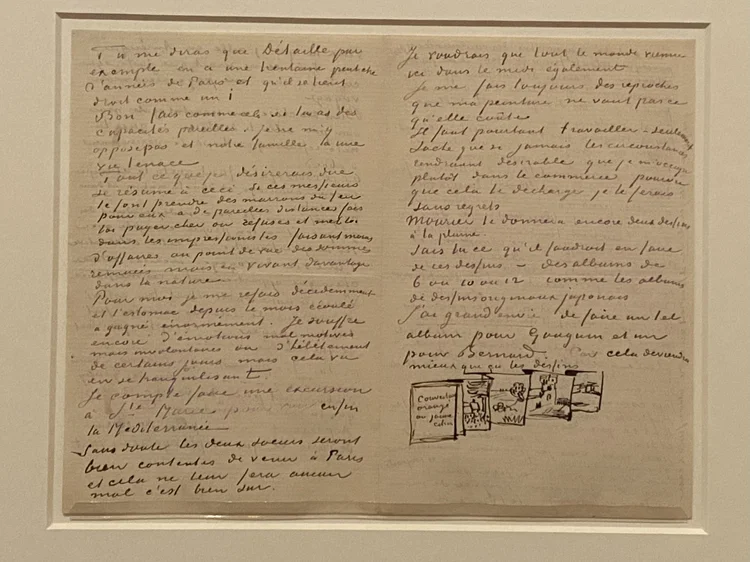
Letter from Vincent van Gogh to Theo van Gogh with a sketch of a leporello, 28 May 1888 (Van Gogh Museum, May 2022) |
|
|
|
Browsing through her poetry books again, I find one of my pressed flower petals inside the poetry collection THERE. In the Light and the Darkness of the Self and of the Other. It kept its red colour and even got brighter as it dried. The resilience of the flower to remain so vivid sent me back to Adnan’s reflections about memory, especially collective memory, being a struggle against death, almost a kind of madness. My tiny red petal found a dwelling place by one of the poems in the collection, entitled HERE: What is here?: a place or an idea, a circle focused in God's eye, a cosmic wave's frozen frame, transient, doomed? Here, where the heat mollifies, when the body surrenders before solicitations could reach it, and there, where the temperature boils the mind and makes it explode into sudden action; here is the point of no return …
Etel Adnan’s oeuvre breathes an endless yearning for beauty, while carrying the weight of the world into multilayered quests in all its contradictions. In accepting the world as it is and finding solace and strength in the act of forgiveness, Adnan has gifted us with her universe, a most wonderful reflection of the greater world surrounding it, and a reminder that the purpose of life is to attain freedom, that the gift of life is freedom. Etel Adnan’s lifelong partner, artist Simone Fattal intimately illustrates this attainment: Etel sits at her table, places before her a small canvas stretched on a wooden frame and starts mixing colour. She does not always begin, as she once did, with a red square, a mark that helped her organize the space around it. She no longer needs to. She feels much freer. She wants to go places, she sees these vast expanses of landscapes, mountains, rivers and plains. She wants to go there, and so she does.
|
|
|
|
Etel Adnan at the Galerie Lelong in Paris (March 2015) |
|
|
|
Essay written in Amsterdam in May 2023, published in De Poëziekrant in Dutch (translated by Martine Wezenbeek) in July 2023. Published in English for the first time in this newsletter. All translations to English in the essay, unless otherwise stated, are my own. Etel Adnan: Surge. 2018.
THERE. In the Light and the Darkness of the Self and of the Other. 1997. Sea & Fog. 2012. “To Write in a Foreign Language” in Thom Donovan and Brandon Shimoda (eds), To look at the sea is to become what one is. An Etel Adnan Reader, vol. 1, New York 2014.
Van Gogh Museum exhibition catalogue:
Etel Adnan Vincent van Gogh. Kleur als taal / Colour as language. With writings by Sara Tas, Simone Fattal, Etel Adnan. Van Gogh Museum en Uitgeverij Tijdsbeeld, 2022.
Translation to English of Sara Tas: Ted Alkins Interviews and hommages: L’entretien infini - Etel Adnan - Conversation avec Hans Ulrich Obrist, Fondation Cartier pour l’art contemporain, 2014. https://youtu.be/IiJqIVzN3z Entretien avec Etel Adnan in Conversation avec Ricardo Karam, 2019 https://ricardokaram.com/podcasts Dominique Eddé, “Etel, l’oiseau rare,” first published in French in L’Orient-Le Jour, 19 November 2021 (https://www.lorientlejour.com/article/1282043/etel-loiseau-rare.html) English translation by Ros Schwartz, January 2022 La beauté de la lumière, entretiens – Etel Adnan & Laure Adler. Avec Laure Adler, Hans Ulrich Obrist & Jean Frémon. Lecture par Nathalie Richard. Rencontre animée par Marie-Madeleine Rigopoulos. 18 mars 2022. https://maisondelapoesieparis.com/programme/la-beaute-de-la-lumiere-entretiens-etel-adnan-laure-adler/
|
|
🎙️ an audio version of the attention span newsletter is available on your favourite podcast app: Spotify, Apple Podcasts, Overcast…or to listen on the attention span website.
|
|
ABOUT Canan “Ja’anan” Marasligil (she/they) is a multilingual writer, artist, literary translator, performer, editor, podcaster and cultural programmes curator based in Amsterdam. She established The Attention Span website and its newsletter to publish their work independently: making the time to reflect, analyse and imagine.
|
|
Thank you so much for reading! Feel free to share this newsletter with your friends, on your social media and more. Here’s the link to subscribe: https://theattentionspan.com/subscribe
When quoting or sharing content, make sure to attribute it to the author. Unless otherwise stated, all content (writing, photography, design) created and published in this newsletter is authored by me, Canan “Ja’anan” Marasligil.
|
|
You can support my work for 3 € a month via my Patron page.
|
|
|
|