|
THE ATTENTION SPAN a monthly invitation for reflection, analysis and imagination by writer, literary translator and artist, canan marasligil. issue 39|movement as inheritance Bali, Indonesia, May 2025
|
issue 39|movement as inheritance
|
|
|
|
Bali, Indonesia, May 2025 |
|
|
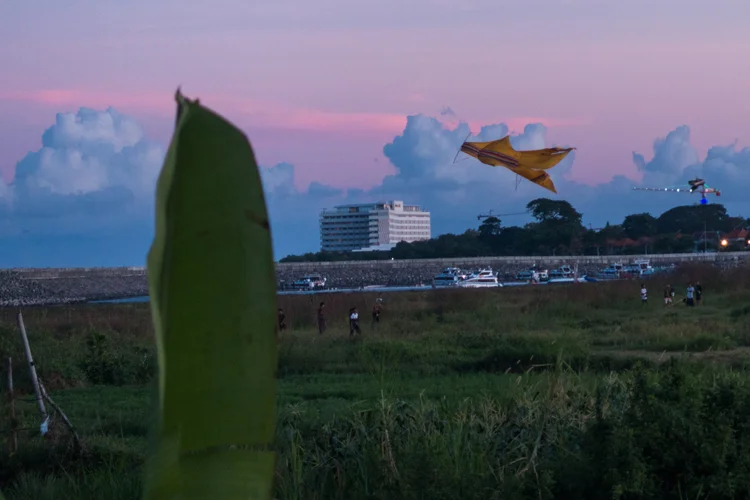
I have always dreamed of seeing the world. From an early age, I yearned for movement —physically, emotionally and intellectually. Travel was never simply a holiday; it was where I found myself. It was also always an invitation for humility: a reminder that there is more to this world than the environment we find ourselves in. Seeing new landscapes, feeling unknown languages, dancing through the unfamiliar rhythms of new cities and streets always mirrors something within me. The simple act of moving from one place to another, even for short distances, would awaken my imagination. Movement has shaped me and my work, and has deeply influenced the way I practice translation. My yearning for movement was so strong that, by the age of fourteen, I began babysitting just to earn enough to start travelling on my own. The moment I turned sixteen — the legal age to work as a student in Belgium — I began working in hotels: cleaning rooms, serving breakfast, managing reception desks. It isn’t surprising I picked these places where people from all sides of the world end up as part of their wider journey. One of the hotels was near the airport. I had my most fascinating conversations with the patrons staying a night or two on their way to catch yet another long haul flight. From sixteen to twenty-four, I worked relentlessly while studying, pouring my earnings into plane tickets and possibilities. If it weren't for the internship position I found at BOZAR, I would have continued working in hotels. I learned so much through these encounters, and all that labour took me to Panama at nineteen, Montreal at twenty-three, Japan and Syria at twenty-five, then more and more travels followed: from Sarajevo to Singapore, from Algiers to Dakar, Seoul to New York… On top of all the European cities that felt way too close to where I was, always wanting to move further away. This was not an escape, but a reclaiming of who I could be.
|
|
|
|
Bali, Indonesia, May 2025 |
|
|
I have inherited this yearning for movement: my family’s migration story spans continents and decades. During the military coup of 1960, my paternal grandfather moved with his family from Türkiye to Germany, returning in 1978 to Istanbul, where my father met my mother. By 1980, the year of yet another military coup in my country of birth, the three of us left Türkiye for Brussels. I was one year old. My father existed without a passport for most of my childhood years, which restrained his possibility for movement to countries limitrophe to Belgium. Our greatest adventure was to run on the Scheveningen beach near The Hague and to see the Netherlands in miniature at Madurodam. I didn’t understand it at the time, but I can now deeply feel my father’s yearning for movement in all these short trips. His attempt to escape a suffocating bureaucratic reality was teaching us the very essence of imagination. Maybe my choosing Amsterdam to settle in has everything to do with those early years of my life. My maternal great-grandmother had also migrated to Germany in 1960. Hamburg became her home. That’s where she is buried. My cousins still live in that port city. I had met my omi for the first time at thirteen in our Brussels home. We spoke in broken German - which I learned through the TV programmes my father used to watch after his shifts at the hotel, and we mixed it with Turkish, the language of our home. We understood one another in and out of translation. Broken and joyful, we were. Always in-between, always in movement. I’ve been told our roots trace back to Crimea, Kyrgyzstan and the Balkans. If I were to take a DNA test, I’d likely find even more geographies woven into me. It’s no wonder, then, that I find myself in movement. And yet, in 2020, all movement stopped. The COVID-19 pandemic grounded the world. What had always been my source of freedom, inspiration, and creativity turned to fear and anxiety. The idea of stepping into the unknown felt dangerous, even reckless. I, who had always moved fearlessly across places, suddenly froze.
|
|
|
|
Bali, Indonesia, May 2025 |
|
|
It took me until February of this year - that’s almost half a decade - to break free from that fear. I travelled to San Francisco, and it opened a long-closed door within me. In May, I went further still: to Jakarta and then to Bali where I was reminded of the world’s beauty: of its nature, of its people, and the possibility to exist beyond materialism. My recent travels were more than physical experiences, they were a reclamation. I felt myself returning. Not just to travel, but to who I am. It is to me a way to honour my migrant heritage to embrace the idea of return, not to specific roots but to movement itself. The late philosopher and linguist George Steiner once expressed gratitude for having legs instead of roots—thankful, in other words, not to be a tree. His words take on a deeper, more poignant meaning when you learn that he and his family left Paris for New York just a month before the Nazi occupation. In French, a simple accent changes the meaning of the word ou. Without the accent, ou means or, a choice. With the accent, où means where, a place. I often reflect on this: how, even in language, movement transforms. It’s this transformation — from where to or, from place to possibility — that captures my practice as an artist and literary translator. Translation itself is movement: between languages, between cultures, between emotional landscapes. It is a crossing, a carrying, a meeting. Just like travel. Just like migration. Today, I hold a European Union passport alongside my Turkish one (so does my father; hope is the thing with feathers…). That duality has gifted me the freedom to move more easily — a privilege I never take lightly. Many are not afforded this ease. And this is one of the reasons I create and translate: to open up imaginative and artistic spaces. To extend the invitation that movement gives — to witness, to feel, to connect — even when bodies cannot follow. Just like my father did when he crossed the two least-guarded borders he knew. It was still a risk, but he took it for us, driven by his belief in the power of imagination. A family of migrants is necessarily a family of dreamers. At least, I know mine is. Movement is not just a choice. It is my geography. I have become the person who finds meaning in movement, who sees the world with wonder and curiosity, with patience and humility. With imagination. Movement once again has become part of who I am, and I cannot wait to continue seeking more of it, so that I can breathe through our world’s beauty, and share my joy every time I return. I find myself in movement.
|
|
|
|
Bali, Indonesia, May 2025 |
|
|
A FEW THINGS THAT MAKE ME THINK AND FEEL… Oceans with David Attenborough, an urgent documentary film about the impact of industrial fishing on our oceans, seas, the climate, and local communities all around the world. Attenborough is a treasure, not just for the UK, for us all. It is a confronting and hopeful film made for everyone, in order to raise awareness on the urgency to create more protected areas in the oceans. The UN Ocean Conference will take place in June 2025 in Nice, the documentary is addressing the importance for the right decisions to be made during that event so that the biodiversity in our oceans can keep evolving and our communities across the world keep being fed and live from what nature has to offer. Not through extraction, but through finding balance. From Foraging to Fame: How Alexis Nikole Nelson became @blackforager is a wonderful episode of the Going Wild with Dr. Rae Wynn-Grant podcast. Alexis Nikole Nelson was raised by a mother who is an avid gardener and a father who loves to cook. Foraging allowed Alexis to fuse her love for wild plants and food from a very young age. But before Alexis became the @blackforager, there was a period in her life where she lost that love and connection to foraging, and where food became very much the enemy. By rediscovering her childhood love of foraging and falling back in love with food and plants, Alexis has inspired millions of her fans to discover the abundance growing freely around them and rethink their own relationship to food.
I’ve been reading a wonderful book titled Dispersals by Jessica J. Lee. Born in Canada to a Taiwanese mother and Welsh father, Lee explores the intersections of plant and human migrations through a series of lyrical essays. Drawing from her background in environmental history and aesthetics, she examines how both flora and people are often perceived as “out of place,” delving into themes of belonging, identity, and the lasting impacts of imperialism. Through personal narrative and scientific insight, Lee invites us to consider the intertwined futures of our natural and human worlds.
|
|
ABOUT + SUPPORT Canan Marasligil (she/they) is a writer, literary translator and artist based in Amsterdam. She established the attention span website and its newsletter to publish their work independently: making the time to reflect, analyse and imagine. thank you so much for reading! you can support the attention span by contributing as much as you’d like between 2,50 € and 25 € via this pay pal link.
|
|
Sharing is loving 🖤 Here’s the link to subscribe: theattentionspan.com/subscribe
When quoting or sharing content, please credit the author. Unless otherwise stated, all content (writing, photography, design) created and published in this newsletter is authored by Canan Marasligil.
|
|
|
|